

AI Notetakers vs. Accountability Agents: What's the Difference?
AI notetakers capture what was said. AI accountability agents close the loop on what was decided. Here's why they're different — and why teams need both.

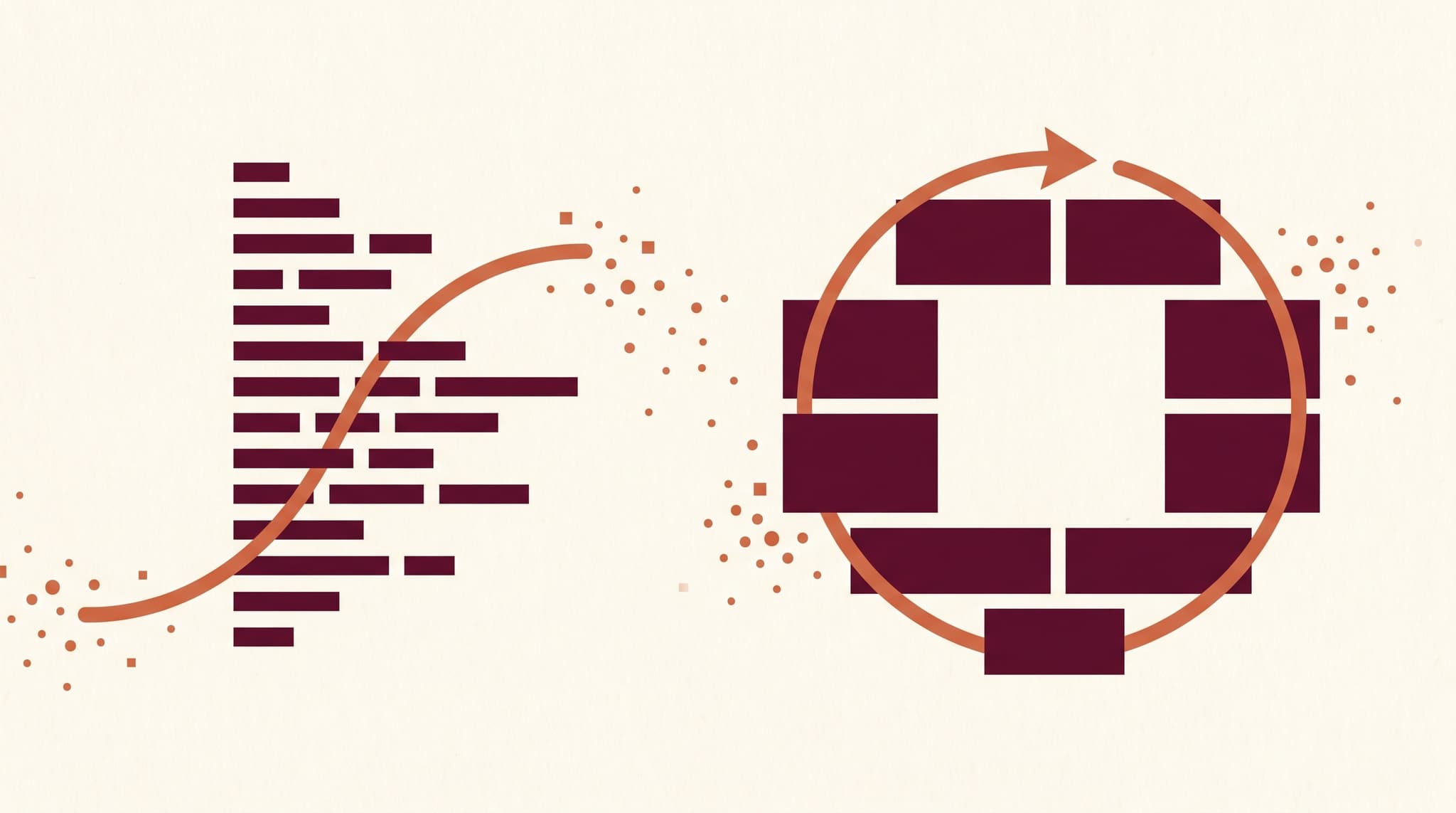
AI notetakers record meetings and produce transcripts, summaries, and an action item list — they capture what was said. AI accountability agents take the commitments made in a meeting and drive them to completion — owners assigned, autonomous reminders sent, overdue items resurfaced in the next agenda. The two categories solve different problems, sit at different points in the meeting workflow, and frequently work better together than either does alone. Most leadership teams already have a notetaker. Almost none have an accountability agent. That gap is where commitments go to die.
This post defines both categories clearly so you can stop confusing them, decide which you need, and understand why the answer for most leadership teams is "both."
Quick Definitions
AI Notetaker — Software that joins or analyzes a meeting (Zoom, Meet, Teams) and produces structured outputs from what was said. The core job is capture: transcript, summary, action items extracted from the conversation, sometimes searchable history. Examples: Granola, Otter.ai, Fathom, Fireflies, Fellow, tl;dv.
AI Accountability Agent — Software that takes the commitments made in a meeting and drives them to completion across the days and weeks that follow. The core job is closure: assigning owners and due dates, nudging owners autonomously across Slack and email, parsing replies, escalating, and surfacing overdue items in the next meeting's agenda. Examples: MeetingTango, Claryti.
Notetakers answer the question "what was said?" Accountability agents answer the question "did what we decided actually get done?"
The Workflow Position They Occupy
A leadership meeting has three distinct phases where software can help. Notetakers and accountability agents sit in different phases.
| Phase | Job | Tool category |
|---|---|---|
| During the meeting | Capture conversation, decisions, commitments | AI notetaker |
| End of meeting → before next meeting | Drive commitments to completion | AI accountability agent |
| Start of next meeting | Surface what slipped, what's outstanding | AI accountability agent |
The notetaker stops working when the meeting ends. Its outputs sit in a doc somewhere — useful, but inert. The accountability agent picks up where the notetaker stops. It takes the captured commitments and runs the workflow that turns them into delivered work.
This is why pitting them against each other is the wrong frame. They are sequential, not competitive.
Why Notetakers Alone Don't Close the Loop
Modern AI notetakers do a remarkable job of capturing what happened in a meeting. They can produce an accurate transcript, identify the key decisions, list the action items with their owners, and summarize the discussion in a paragraph or two. The output is genuinely useful.
But producing the list is not the same as completing the items on it.
A team running a notetaker after every meeting still hits roughly the 44% action item completion rate that has been the baseline across most teams for years (Atlassian). The notetaker improved capture quality — fewer items get missed during transcription — but the completion rate did not move. The reason is structural: a list of action items, no matter how well captured, requires ongoing intervention between meetings to actually drive completion. The list itself does nothing.
The work that has to happen between meetings looks like this:
- Someone confirms each owner agreed to their commitment
- Someone reminds owners 24–48 hours before their due dates
- Someone parses replies when owners say "I need more time" or "I'm blocked"
- Someone escalates when items go past due
- Someone surfaces overdue items at the top of the next meeting
A notetaker does none of those things. It made the list. The list now needs an operator. Most teams assign the operator role implicitly to a chief of staff, a founder, or a COO — which is why it eventually breaks down. The operator burns out, gets pulled into other work, goes on vacation, or stops doing the maintenance because they have more important things to do.
The accountability agent is software that takes the operator role.
Why Accountability Agents Alone Don't Replace Notetakers
The reverse problem also exists. An accountability agent that does not have a capture layer in front of it is asking a human to type commitments into a system in real time during the meeting — which is what most teams already fail at.
The accountability agent needs an input feed. Either:
- A human types action items as they get committed (works, but adds friction during the meeting)
- The accountability agent integrates with a notetaker that has already extracted the commitments (much smoother)
- The accountability agent reads from your team's existing notes doc (works if the doc is consistent)
The simplest, lowest-friction setup is the second one: your existing notetaker (Granola, Otter, Fathom, whatever) captures the meeting and produces the action item list, and your accountability agent consumes that list and runs the workflow against it.
This is why accountability agents are designed to work on top of the notetaker layer, not replace it. The categories complement each other.
The Side-By-Side Comparison
For readers who skim, here's the comparison in one table.
| Dimension | AI Notetaker | AI Accountability Agent |
|---|---|---|
| Core job | Capture the conversation | Close the loop on commitments |
| Active when | During the meeting | Between meetings, and at the start of the next |
| Inputs | Audio / video of the meeting | Action item list (often from a notetaker) |
| Outputs | Transcript, summary, action item list | Completion (or surfacing of slips) |
| Joins the meeting? | Often (as a bot in Zoom/Meet/Teams) | No |
| Records audio? | Usually, yes | No |
| Privacy posture | Recording-dependent | No-recording, no-bots |
| Primary value | You don't lose what was said | What was decided actually gets done |
| Failure mode | Output sits in a doc no one reopens | Has nothing to act on if no capture exists |
| Buyer in a leadership team | Often the COO or chief of staff | The CEO who is tired of chasing people |
| Example products | Granola, Otter, Fathom, Fellow | MeetingTango, Claryti |
The dimension that matters most for buyers is the second-to-last row: who in the leadership team feels the pain. The notetaker buyer feels the pain of "we lose track of what got discussed." The accountability agent buyer feels the pain of "we agreed on it and then it didn't happen."
These are often the same person feeling two different pains. Both are real. Both have software answers. They are different software.
Why People Confuse Them
The two categories get confused for a few reasons.
Notetakers extract action items, so they sound like accountability tools. When Otter produces a list of action items at the end of a Zoom call, it feels like that should be enough. The list is right there. Owners are named. What more do you need? The "more" you need is a workflow that runs against the list for the next seven days. Extraction is not execution.
The marketing language overlaps. Both categories use phrases like "never miss an action item" or "make meetings actionable." The notetaker version of that promise is about capture fidelity. The accountability agent version is about completion. When you read those phrases, ask yourself: is this product making sure I don't forget what got decided, or is it making sure what got decided actually happens?
Some products try to do both, badly. A handful of products bundle a notetaker and an accountability layer in the same tool. In practice, the accountability layer is usually thin — reminder emails, maybe an integration to a project management tool. The deep work of nudging owners across channels, parsing replies, and managing escalation tends not to exist. So the product looks like it solves both problems but only solves one.
Leadership teams have been told "AI is going to fix meetings" for years. When that promise gets concrete, it usually means a notetaker. The accountability category is newer, smaller, and less well-defined in most buyers' minds. The default assumption when someone says "AI for meetings" is still "notetaker."
When to Buy Each (And When to Buy Both)
The buying decision usually comes down to which pain is more acute right now.
Buy a notetaker first if:
- Your team forgets what was discussed (the conversation history is fragmented)
- You spend significant time hunting through Slack threads to remember what someone said
- People who miss the meeting are not getting up to speed
- You need a searchable record of decisions for legal, compliance, or HR reasons
Buy an accountability agent first if:
- Your team agrees on things and then they don't happen
- You can list 5+ commitments from last month's meetings that are still open with no clear status
- Your CEO or COO has become the part-time follow-up chaser
- The action items from your notetaker are already being captured — they just are not getting done
Buy both if:
- Both pains are real (this is the typical leadership team at 30+ employees)
- You want to maximize the leverage of AI across the meeting lifecycle
- You can afford it (the combined cost is typically $50–$100 per team per month at the leadership team scale, which is cheap relative to the alternative of paying a chief of staff to do this work manually)
The order does not matter very much. Whichever pain hurts more, fix first.
What This Looks Like in Practice
Imagine a leadership team of 8 people running a weekly Monday meeting. They adopt Granola for note-taking and MeetingTango as the accountability agent on top of it.
Monday, 9:00 AM. The meeting starts. Granola is listening (as a participant in the Zoom or via the desktop app). The team works through the scorecard, the issues list, and a couple of strategic discussions. As decisions get made, the facilitator says "owner, date, what exactly" and Granola captures each commitment in its action items panel. The meeting ends at 10:00 AM with 12 captured commitments, each with an owner and a date.
By 10:30 AM, MeetingTango has read the commitments from the Granola export. It confirms each owner via Slack with a one-click "yes, I committed to this" acknowledgment. Owners that don't respond get a gentle follow-up the next morning.
Through the week, MeetingTango sends reminders 24 hours before each due date. When an owner responds in Slack that they're blocked, the agent parses the reply, marks the item as blocked, and adds context for the next meeting. Items that pass their due date without resolution get escalated — first to the owner, then surfaced on the team dashboard.
Monday, 9:00 AM, one week later. The team opens the meeting with MeetingTango's overdue and at-risk list at the top of the agenda. Of the 12 items from last week, 10 are done, 1 is rescheduled with a new date, 1 is blocked (the team discusses how to unblock it). The cycle starts again.
The notetaker did the capture. The accountability agent did the closure. Neither could have done both jobs well. Together they replace what used to be 6–8 hours per week of chief-of-staff manual work, and they lift action item completion from the 44% baseline to 85%+.
The "But My Notetaker Already Does Reminders" Question
This comes up a lot. Some notetakers offer a basic reminder feature — they will email the owner once on the day an action item is due.
That is not an accountability agent. It is a single-shot email reminder, which is better than nothing but does not solve the structural problem. A real accountability layer does the following things that single-shot reminders don't:
- Sends nudges before the deadline (24–48 hours out, when the owner can still act), not on the day
- Sends in the owner's preferred channel (Slack DM for some, email for others)
- Parses replies and updates status automatically, instead of requiring the owner to log in somewhere
- Escalates when items go past due without resolution
- Surfaces a curated overdue list at the top of the next meeting, not just a list of all items
- Tracks completion rate over time as a team health metric
A reminder feature is to an accountability agent what a calendar invite is to a meeting facilitator. Same general direction, different scope of work.
Privacy Differences
One more dimension worth flagging: the privacy posture of the two categories is meaningfully different.
Notetakers, by their nature, record audio. To produce a transcript and extract action items, they need the conversation in some form — either a recording, a live audio stream, or both. This raises real questions about consent, data residency, and what happens if a sensitive conversation (executive comp, customer churn, legal exposure) ends up in the notetaker's cloud storage.
Accountability agents that work on top of the notetaker layer do not need to record anything. They read the action items the notetaker produced (or that a human typed) and run their workflow against text. No audio, no transcripts, no bots in the meeting room. The privacy surface is smaller.
For leadership teams that handle sensitive material — most of them — this distinction matters. You may want to use a notetaker for routine meetings but not for board prep or legal review. You can use an accountability agent across all of them safely.
Common Mistakes
Buying a notetaker and assuming completion will follow. It will not. The notetaker fills the capture gap. The completion gap is separate.
Buying an accountability agent without any capture mechanism. The agent has nothing to act on. Either pair it with a notetaker, type items in real time, or commit to a notes-doc workflow with a consistent format.
Confusing summary quality with execution quality. Notetakers compete on how good their summaries are. Accountability agents compete on completion rates. Different metrics, different tools.
Letting the notetaker's action item list become the system. The list itself does nothing. If your team is treating the auto-generated list as the workflow, you are running on hope.
The Bottom Line
AI notetakers and AI accountability agents are not the same category. They sit at different points in the meeting workflow, solve different problems, and reward different buyer pains. Most leadership teams need both — the notetaker to capture, the accountability agent to close the loop.
If you can only buy one, buy the one that solves your more acute pain. If your team forgets what was decided, start with a notetaker. If your team decides and then nothing happens, start with an accountability agent.
For most leadership teams, the accountability gap is the more expensive one. Capture failure is annoying. Execution failure is the reason the strategy doesn't move.
See It in Action
MeetingTango is the AI accountability agent for leadership teams. It works on top of your existing notetaker (Granola, Otter, Fathom, Fellow, or human-typed notes), runs the close-the-loop workflow autonomously, and surfaces overdue items at the top of your next meeting's agenda. No recording, no bots, no transcription — it operates on the commitments, not the audio.
Join the waitlist to get access as soon as we open.
Related Reading
- Why Meeting Action Items Never Get Done (And the Fix) — The data and the systemic reasons commitments die
- The Meeting Follow-Up: A System for Closing the Loop — The five-step close-the-loop framework
- Action Item Tracker: The 4 Types That Actually Work — How the tracker categories rank by completion rate
- Stop Recording Your Meetings — Why the no-recording posture is the right one for leadership work
- AI Meeting Coach — The Full Lifecycle — Where accountability fits in the broader meeting-coaching vision