What Is the Balanced Scorecard? A Strategic Management Guide
The Balanced Scorecard (BSC) translates strategy into four measurable perspectives: Financial, Customer, Internal Process, and Learning & Growth. Learn how to implement it.

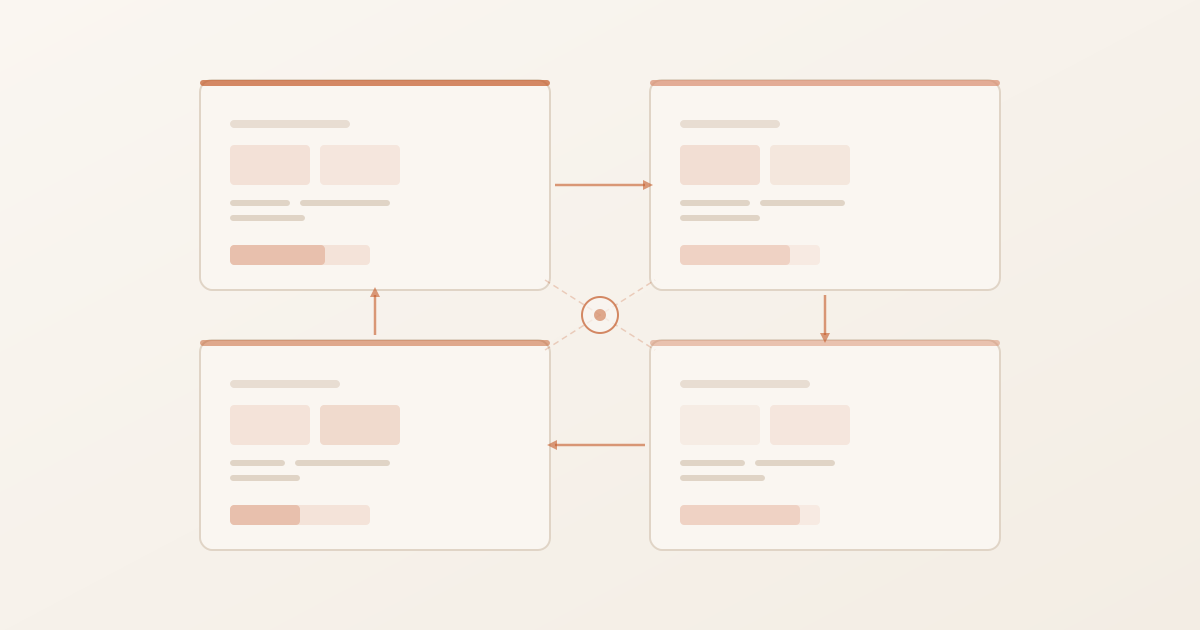
Most companies have a strategy. Few can measure whether it's working. Leaders launch ambitious initiatives, set bold goals, and rally their teams around a shared vision—only to discover six months later that nothing has actually changed. Financial results lag behind, customer satisfaction drifts, and internal processes remain as broken as ever. The Balanced Scorecard was invented to fix this problem by turning strategy into something you can track, manage, and improve.
This guide covers everything you need to know about the Balanced Scorecard: its origins, four perspectives, strategy maps, implementation steps, and how it compares to other popular frameworks. If you're evaluating business operating systems or trying to improve strategy execution at your company, the BSC deserves serious attention.
What Is the Balanced Scorecard?
The Balanced Scorecard (BSC) is a strategic management framework developed by Robert S. Kaplan and David P. Norton in 1992. It was first introduced in a Harvard Business Review article titled "The Balanced Scorecard: Measures That Drive Performance" and later expanded in their 1996 book The Balanced Scorecard: Translating Strategy into Action.
The core insight behind the BSC is simple but powerful: financial metrics alone cannot tell you whether your strategy is working. Profits and revenue are lagging indicators—they tell you what already happened, not what's about to happen. By the time your financials decline, the root causes are months old.
The core premise: A balanced approach to performance measurement requires tracking four interconnected perspectives—Financial, Customer, Internal Process, and Learning & Growth. Together, they provide a complete picture of organizational health and strategic progress.
The BSC has been adopted by more than half of Fortune 1000 companies. Government agencies, nonprofits, healthcare systems, and educational institutions also use it. Bain & Company has consistently ranked it among the top management tools worldwide.
The Four Perspectives
The Balanced Scorecard organizes strategic objectives into four distinct perspectives. Each one answers a fundamental question about the organization's performance.
| Perspective | Core Question | Focus Area |
|---|---|---|
| Financial | How do we look to shareholders? | Revenue growth, profitability, cost management, ROI |
| Customer | How do customers see us? | Satisfaction, retention, acquisition, market share |
| Internal Process | What must we excel at? | Operational efficiency, quality, innovation, cycle time |
| Learning & Growth | Can we continue to improve and create value? | Employee skills, culture, technology, knowledge management |
The perspectives are not independent. They form a cause-and-effect chain: improvements in Learning & Growth drive better Internal Processes, which create better Customer outcomes, which ultimately deliver Financial results.
Financial Perspective
The financial perspective captures the ultimate outcomes that shareholders and owners care about. But unlike traditional financial management, the BSC uses financial goals as a destination, not a starting point.
Common financial objectives include:
- Revenue growth: Increasing top-line revenue through new markets, products, or customer segments
- Cost reduction: Improving operational efficiency to protect margins
- Asset utilization: Getting more output from existing investments
- Shareholder value: Increasing return on equity, economic value added, or other value metrics
The key shift is linking financial targets to the specific customer, process, and people strategies that will produce those results. A goal of "increase revenue by 15%" means nothing without a clear causal path.
Customer Perspective
The customer perspective measures how well you're delivering value to the people who pay you. This is where strategy meets the market.
Common customer objectives include:
- Customer satisfaction scores: Are customers happy with your product or service?
- Net Promoter Score (NPS): Would customers recommend you to others?
- Customer retention rate: Are customers staying year over year?
- Customer acquisition cost: How efficiently are you attracting new customers?
- Market share: Are you gaining or losing ground against competitors?
The customer perspective also includes your value proposition—the specific combination of product quality, price, service, and relationship that you offer. Are you competing on operational excellence (low cost, high reliability), product leadership (innovation, best features), or customer intimacy (deep relationships, customized solutions)?
Internal Process Perspective
This perspective identifies the critical operational processes that must function well to deliver the customer value proposition and achieve financial goals.
Common process categories include:
- Operations management: Production, delivery, supply chain efficiency
- Customer management: Acquisition, retention, deepening relationships
- Innovation: R&D pipeline, new product development, time to market
- Regulatory and social: Compliance, environmental stewardship, community impact
The internal process perspective is where organizations often discover their biggest gaps. Leaders frequently set ambitious customer and financial goals without examining whether their processes can actually support them.
Learning & Growth Perspective
Learning & Growth is the foundation of the entire scorecard. It addresses the intangible assets—people, technology, and culture—that enable everything above it.
Three categories of intangible assets:
- Human capital: Employee skills, knowledge, competencies, and experience
- Information capital: Systems, databases, networks, and technology infrastructure
- Organization capital: Culture, leadership, alignment, and teamwork
Key insight: Most organizations underinvest in Learning & Growth because the payoff is indirect and delayed. But neglecting this foundation guarantees that process improvements, customer gains, and financial targets will eventually stall.
Strategy Maps: Visualizing the Cause-and-Effect Chain
In 2004, Kaplan and Norton published Strategy Maps, which introduced a visual tool for connecting objectives across all four perspectives. A strategy map shows how investments in learning and growth drive process improvements, which drive customer outcomes, which drive financial results.
A simplified strategy map might look like this:
- Financial: Increase profit margins by 10%
- Customer: Improve customer retention from 75% to 90%
- Internal Process: Reduce average resolution time from 48 to 12 hours
- Learning & Growth: Train all support staff on new CRM platform
Each objective connects to the ones above it through a clear causal hypothesis. Strategy maps make these connections explicit so the entire organization can see how their work contributes to the big picture.
Building an Effective Strategy Map
Follow these steps to build your strategy map:
- Start with financial goals: What does success look like for the business?
- Define the customer value proposition: Who are your target customers and what do they value most?
- Identify critical processes: Which internal processes must improve to deliver that value?
- Assess intangible assets: What skills, technology, and culture changes are needed to drive those processes?
- Draw the connections: Map cause-and-effect relationships between objectives
- Validate with data: Test your hypotheses by tracking whether leading indicators actually predict lagging results
How to Build a Balanced Scorecard
Implementing a BSC requires disciplined thinking and organizational commitment. Here is a practical step-by-step guide.
Step 1: Clarify Your Strategy
Before you measure anything, get clear on what you're trying to achieve. Define your mission, vision, core values, and strategic priorities. If your leadership team can't articulate the strategy in plain language, you're not ready for a scorecard.
Step 2: Identify Strategic Objectives
For each of the four perspectives, identify 3-5 strategic objectives. These should be specific, actionable, and linked to the strategy. Aim for 12-20 total objectives across all perspectives.
| Perspective | Example Objectives |
|---|---|
| Financial | Grow recurring revenue by 20%; Improve gross margin to 65% |
| Customer | Achieve NPS of 60+; Reduce churn to 5% annually |
| Internal Process | Launch 3 new features per quarter; Reduce onboarding time to 2 days |
| Learning & Growth | Achieve 90% employee engagement; Complete leadership training for all managers |
Step 3: Select Measures and Targets
For each objective, choose 1-2 measures (KPIs) and set specific targets. Measures should be quantifiable, reliable, and within the organization's ability to influence.
Step 4: Define Strategic Initiatives
Initiatives are the projects and programs that will move the measures toward their targets. Each initiative should have an owner, a budget, a timeline, and clear deliverables. Without initiatives, a scorecard is just a dashboard—it measures but doesn't drive change.
Step 5: Build the Strategy Map
Connect your objectives across perspectives to show cause-and-effect relationships. This step often reveals gaps: financial goals without supporting customer strategies, or customer promises without the process capability to deliver them.
Step 6: Cascade Throughout the Organization
The enterprise scorecard needs to cascade down to business units, departments, teams, and individuals. Each level creates its own scorecard aligned with the level above. This cascade is what turns strategy from a leadership exercise into an organization-wide operating system.
Step 7: Review and Adapt
The BSC is not a set-it-and-forget-it tool. Schedule monthly reviews to track progress, quarterly reviews to adjust targets and initiatives, and annual reviews to refresh the strategy itself. Use your scorecard as a living document, not a reporting artifact.
BSC vs KPIs vs OKRs
The Balanced Scorecard is often confused with other performance frameworks. Here is how they differ and where they overlap.
| Dimension | Balanced Scorecard | KPIs | OKRs |
|---|---|---|---|
| Purpose | Translate strategy into measurable objectives | Track specific performance metrics | Set ambitious goals with measurable results |
| Structure | 4 perspectives with strategy map | Flat list of metrics | Objectives with 3-5 Key Results each |
| Time Horizon | Long-term (3-5 years) with annual/quarterly milestones | Ongoing | Quarterly (typically) |
| Scope | Organization-wide strategic alignment | Any level, any function | Team and individual goals |
| Strategy Link | Explicit cause-and-effect chain | Varies — often disconnected | Varies — can be disconnected |
| Best For | Strategic alignment and communication | Operational monitoring | Agile goal-setting and focus |
The truth is, these frameworks are complementary, not competing. Many organizations use a BSC for strategic alignment, KPIs for operational monitoring, and OKRs for quarterly goal-setting. The BSC provides the strategic "why," KPIs provide the operational "what," and OKRs provide the tactical "how."
For a deeper dive into OKRs, see our complete guide to OKRs or explore OKR software options.
Using the Balanced Scorecard With Other Frameworks
The BSC integrates well with many popular business operating systems. Here's how it fits with frameworks you may already be using.
BSC + EOS
The Entrepreneurial Operating System focuses on vision, people, data, issues, process, and traction. The BSC adds strategic depth by providing:
- A structured way to define and track the Data component across four dimensions
- A strategy map that deepens the Vision/Traction Organizer (V/TO)
- A cascading measurement system that extends beyond weekly Scorecards
BSC + Scaling Up
Scaling Up's One-Page Strategic Plan covers similar ground to the BSC, but the scorecard adds rigor to the measurement side. Combining them gives you Scaling Up's strategic frameworks plus the BSC's disciplined measurement cascade.
BSC + OKRs
OKRs provide quarterly agility. The BSC provides long-term strategic alignment. Use the BSC to set the strategic direction and OKRs to set quarterly priorities that advance each perspective. Your strategy execution improves when both work together.
Common Mistakes to Avoid
Organizations that struggle with the BSC often make these errors:
- Too many measures: A scorecard with 50 KPIs is a data dump, not a strategy tool. Keep it to 15-25 measures across all perspectives.
- No cause-and-effect thinking: Listing objectives without connecting them is just categorization. The power of the BSC is in the causal chain.
- Financial bias: Loading up the financial perspective with 10 measures while giving Learning & Growth only 2 defeats the purpose of balance.
- No cascading: A corporate scorecard that never reaches teams and individuals is a leadership toy, not a management system.
- Static implementation: Strategies change. Markets shift. If your scorecard doesn't evolve at least annually, it becomes irrelevant.
- Measuring what's easy, not what matters: Don't choose metrics because they're available. Choose them because they measure strategic progress.
Who Should Use the Balanced Scorecard?
The BSC works best for organizations that:
- Have a clear strategy that needs to be translated into measurable objectives
- Employ 50+ people across multiple departments or business units
- Need to align diverse teams around a shared strategic direction
- Want to balance financial performance with customer, process, and people metrics
- Are ready to invest in a long-term management discipline, not a quick fix
- Operate in industries where intangible assets (knowledge, relationships, brand) drive competitive advantage
Smaller organizations can also benefit, especially if they're scaling and need a structured way to keep strategy connected to execution.
Getting Started With the Balanced Scorecard
Phase 1: Education and Commitment (Weeks 1-4)
- Read The Balanced Scorecard and Strategy Maps by Kaplan & Norton
- Secure leadership commitment—the BSC requires top-down sponsorship
- Assemble a cross-functional team to lead the implementation
- Assess your current strategic clarity and measurement maturity
Phase 2: Strategy and Objectives (Weeks 4-8)
- Clarify or refine your organizational strategy
- Define 3-5 objectives per perspective (12-20 total)
- Build your strategy map showing cause-and-effect connections
- Select measures and set targets for each objective
Phase 3: Cascade and Communicate (Weeks 8-16)
- Cascade the enterprise scorecard to business units and departments
- Define strategic initiatives with owners, budgets, and timelines
- Communicate the scorecard to the entire organization
- Set up tracking systems—your scorecard tool should support this
Phase 4: Manage and Improve (Ongoing)
- Conduct monthly scorecard review meetings
- Adjust initiatives that are underperforming
- Refine measures as you learn what actually predicts outcomes
- Refresh the strategy and scorecard annually
A word on technology: The BSC works on whiteboards and spreadsheets, but scaling it across an organization requires purpose-built tools. A digital scorecard platform ensures that metrics stay visible, updates happen consistently, and cascading stays aligned.
Bringing It All Together
The Balanced Scorecard is more than a measurement tool—it's a strategic management system that keeps your entire organization focused on what matters. By balancing financial outcomes with customer value, process excellence, and organizational learning, it provides a complete picture of performance that purely financial metrics cannot.
Whether you adopt the BSC as your primary strategy execution framework, combine it with EOS or OKRs, or simply use its four-perspective model to think more holistically about your business, the principles are universally valuable. Strategy only creates value when it gets executed—and execution only works when you can measure what matters.
Meeting Tango's Balanced Scorecard tools help you build, cascade, and track your scorecard digitally—so your strategy stays visible and actionable across every level of the organization.